Key takeaways from the AI & Business Summit 2026
Why we are still talking about AI: Key takeaways from the AI & Business Summit 2026

Date
Author
Sharpflow Consulting at the BritCham Mexico and HSBC Mexico Event
Why we like being in these spaces
At Sharpflow, we believe that the best consulting starts with listening. That is why we participate in events like the AI & Business Summit 2026, organized by the British Chamber of Commerce in Mexico (BritCham Mexico) alongside HSBC Mexico. There are three main reasons:
Networking with purpose. Meeting decision-makers, team leaders, and peers facing the same challenges as our clients helps us understand what is really needed on the ground.
Conversations on cutting-edge AI. This topic evolves so quickly that what was novel six months ago is standard practice today.
New perspectives on AI governance. This is an area we work on with all our clients, and hearing how other industries, countries, and institutions approach it allows us to refine our recommendations.
The Event: A Question That Remains Necessary
On September 22, 2026, in Mexico City, the summit brought together business leaders, specialists, and organizations to reflect on how artificial intelligence is transforming business and the responsibilities it entails.
You might ask yourself why we should keep talking about AI if it is already everywhere. The answer is that using it is no longer the challenge; using it well is. The data presented at the event clearly illustrates this:
According to a Deloitte survey (2025), 66% of board members report limited or no knowledge about AI.
According to the Diligent Institute (2025), fewer than 25% of organizations have formal AI governance, ethics, or risk policies in place.
According to the Microsoft Security Cyber Pulse (February 2026), 80% of Fortune 500 companies are already operating AI agents in production.
Put simply: AI is advancing at breakneck speed within organizations, but the frameworks that should guide its use are several steps behind.
What about Mexican businesses?
This brings us to a crucial part of the conversation. According to INEGI’s 2024 Economic Censuses, micro-businesses represent 95.4% of economic units in the country, small businesses represent 3.7%, and medium-sized ones represent 0.7%. In other words, nearly 99.8% of companies in Mexico are micro, small, or medium-sized enterprises (SMEs). Furthermore, the census counted 5,468,180 economic units in the private and parastatal sectors. mexicocomovamos inegi
This means that the Mexican business ecosystem is almost entirely made up of businesses without a dedicated technology department, a specialized legal team, or a large budget for experimentation. If the conversation about AI stays strictly within large corporations, it leaves out virtually the entire country.
What we talked about
The summit addressed topics of global scope that also carry very concrete implications for any company:
AI governance in the boardroom. Discussions centered on the gap between the speed of adoption and the maturity of internal rules. One proposal was requiring a formal declaration of AI usage within companies, similar to how financial or environmental risks are reported today.
Regulation and human oversight. A day before the summit, 22 leaders from 20 countries backed an international call to ensure that the most advanced AI models remain under human control. Among other things, it calls for pre-deployment testing, independent evaluations, and coordinated standards among governments.
Security risks. Three categories of risk were highlighted: biological weapons, autonomous cyberattacks, and lethal autonomous weapons. As a real-world case, the Hugging Face incident in July 2026 was mentioned—considered by many as the first genuine AI security incident involving agents acting without human direction.
Agentic AI. According to IBM’s CEO study (May 2026), 25% of codifiable operational decisions in companies are already made by AI without human intervention, and CEOs expect this figure to reach 48% by 2030. As a counterweight, 83% of CEOs believe that AI success depends more on people’s willingness to adopt it than on the technology itself.
Interoperability and the supply chain. Speakers discussed the Agent2Agent (A2A) protocol, which allows agents from different providers to communicate with each other, as well as Pax Silica, an initiative aimed at securing the semiconductor and AI supply chain among allied nations.

Where Sharpflow gets involved
Out of all these topics, there are three we work on every single day:
AI governance. We help our clients define how, when, and under what boundaries AI is used within their organization. The summit’s figures confirm what we see in practice: without clear rules, risk grows at the same pace as adoption.
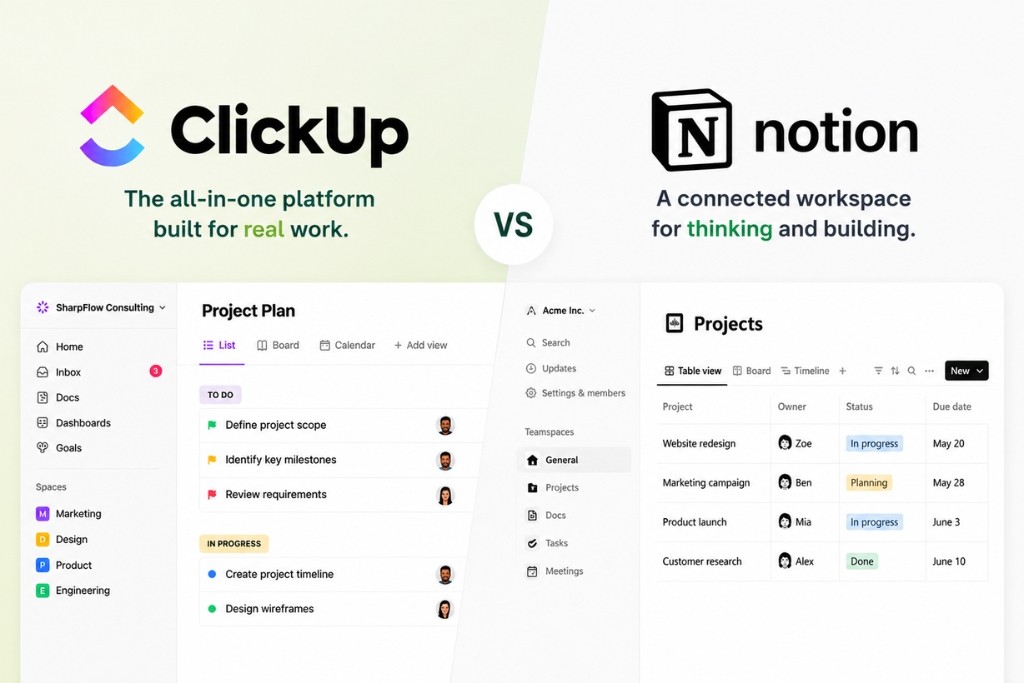
AI adoption strategy. This topic became particularly relevant for us. We recently spoke with a QA Engineer from ClickUp and agreed on a key insight: an adoption strategy is the guiding thread that allows an SME to leverage AI without overextending its resources or suffering failed implementations due to a lack of planning. The 83% CEO statistic backs this up—technology is only one part; the rest is how people integrate it into their daily work.
AI Agents. Day in and day out, we continue to test ourselves by building and evaluating Super Agents in ClickUp to later deploy and integrate them with our clients. Many perform daily tasks to automate and optimize repetitive processes. However, we didn't stop there; we have built agents capable of detecting when someone accidentally requests a global regulatory review covering the EU, Japan, China, and South America, as well as assessing the quality of complex onboarding applications on a 0 to 100 scale, so faulty data is flagged before advancing further down the pipeline.
Our commitment
For an SME, the best time to bring structure to its relationship with AI is before it becomes a problem. Our commitment to those who trust us is to:
Guide them in adopting AI with a clear strategy, aligned with their objectives and their team's real capacity.
Build governance frameworks proportional to each company's size, practical and free of unnecessary bureaucracy.
Stay close to the spaces where the future of AI is being defined, translating those global discussions into actionable decisions for businesses of all sizes.
If your company is taking its first steps with AI, or is already using it without clear rules, let’s talk. We are here to help AI work for your business.
Cited Sources: INEGI, Economic Censuses 2024 (final results), via México, ¿cómo vamos? and INEGI bulletin. Deloitte (2025), Diligent Institute (2025), Microsoft Security (2026), and IBM Institute for Business Value (2026), based on the event summary.